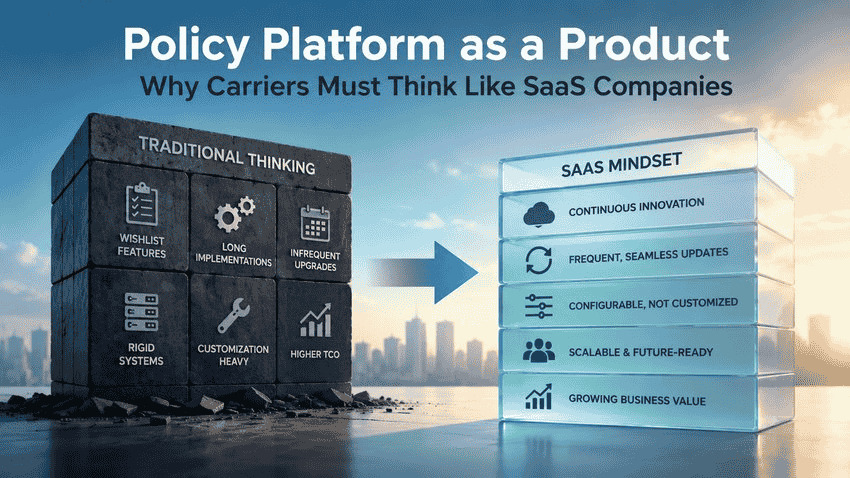
The insurance industry is undergoing a significant technology shift. For decades, insurers relied on large, internally managed systems for policy administration, claims, underwriting, billing, and customer service. Today, SaaS in the insurance industry is helping carriers modernize these functions without requiring every application to be built, hosted, and maintained internally.
Software as a Service (SaaS) delivers software applications over the internet, allowing organizations to access technology without managing the underlying infrastructure themselves. The U.S. Department of the Treasury’s review of cloud services describes SaaS as an end-user application delivered as a service, while cloud models can provide insurers with scalable computing and storage capabilities.
Why SaaS Is Becoming Important for Insurers
Insurance companies operate in a data-intensive environment. Underwriters evaluate risk, claims teams process large amounts of documentation, actuaries analyze historical information, and customer-service teams need quick access to policy information.
Traditional technology environments can make these processes difficult to change quickly. SaaS platforms can provide a more flexible technology layer that can be updated centrally and integrated with other systems.
The opportunity is particularly relevant as insurers modernize their technology stacks. Deloitte's insurance technology research highlights cloud migration, data transformation, cybersecurity, AI infrastructure, and modernization as strategic priorities for insurers.
For insurance executives, however, the value of SaaS should not simply be measured by replacing legacy software. The bigger opportunity is creating an operating environment where data, automation, analytics, and employees can work together more efficiently.
SaaS Applications Across the Insurance Value Chain
The potential applications extend across virtually every major insurance function.
Underwriting: SaaS platforms can consolidate data from multiple sources and provide underwriters with faster access to information. When combined with analytics or AI, these systems can help insurers identify patterns and support more informed risk assessment.
Claims: Cloud-based claims platforms can help organize documents, communications, images, estimates, and workflow information. Automation can reduce repetitive administrative tasks and allow claims professionals to focus on more complex cases.
Customer service: Digital SaaS applications can provide policyholders and agents with self-service capabilities, including policy information, claim updates, payments, and communications.
Distribution: Agents and brokers can benefit from centralized systems that make quoting, submissions, customer management, and policy servicing more accessible.
The National Association of Insurance Commissioners (NAIC) notes that insurtech is already influencing areas such as product design, risk assessment, policy sales, claims handling, and customer interaction.
The Next Advantage: SaaS + AI
One of the most important developments is the convergence of SaaS and artificial intelligence.
Modern insurance SaaS platforms increasingly incorporate AI capabilities for document processing, customer interactions, fraud detection, underwriting support, and claims workflows. NAIC identifies underwriting, pricing, claims, customer service, marketing, and fraud detection among the insurance areas where AI is being used.
Deloitte's 2025 insurance technology research also points to the growing role of small language models, human-in-the-loop operating models, AI-enabled products, and modernization of core systems.
This creates an important distinction: the future of insurance SaaS is not simply about putting existing software in the cloud. It is about creating intelligent platforms that can turn insurance data into actionable information.
A New Insight: SaaS Can Improve Insurance Agility
For insurance executives, agility may be one of the most important benefits of SaaS.
Insurance markets change quickly. Catastrophe exposure, emerging risks, customer expectations, regulatory requirements, and competitive pressures can all affect operating priorities.
A flexible SaaS environment can make it easier to introduce new workflows, integrate external data, and connect specialized applications. This can reduce the technology friction associated with launching or modifying processes.
That matters because insurers increasingly need to move from technology projects that take years toward continuous modernization.
Security and Regulatory Governance Still Matter
SaaS adoption does not eliminate technology risk. Insurance companies handle highly sensitive personal, financial, health, and commercial information, making security and governance essential.
The NAIC's Model Bulletin on the Use of Artificial Intelligence Systems by Insurers emphasizes responsible governance, risk management, fairness, accuracy, and compliance with applicable insurance laws.
The same principle applies when insurers use third-party SaaS providers. Before adopting a platform, insurers should evaluate areas such as data ownership, access controls, encryption, incident response, business continuity, vendor risk, auditability, and regulatory obligations.
AI adds another layer. Insurers need to understand not only where their data is stored but also how automated systems use that data and how decisions can be monitored.
What Insurance Leaders Should Evaluate
Choosing a SaaS platform should go beyond price and feature comparisons. Insurance leaders should ask:
- Can the platform integrate with existing core systems?
- How easily can data be accessed and governed?
- What security controls does the provider offer?
- Can the platform scale as business requirements change?
- How transparent are AI-supported decisions?
- What happens to data when the contract ends?
- Does the vendor support regulatory and audit requirements?
- Can employees remain involved in important decisions?
These questions help insurers distinguish between a simple software subscription and a technology platform capable of supporting long-term transformation.
The Future of SaaS in Insurance
The growth of SaaS in the insurance industry is likely to continue as carriers modernize legacy environments and seek more flexible technology models. The most successful implementations will not treat SaaS as an isolated IT purchase.
Instead, insurers can use SaaS as a foundation for connecting cloud infrastructure, analytics, automation, AI, customer experiences, and specialized insurance applications.
Deloitte's research found that 76% of surveyed U.S. insurance executives had implemented generative AI in at least one business function, illustrating how quickly technology adoption is moving beyond experimentation.
The strategic opportunity is therefore broader than moving software to the cloud. SaaS can help insurers build a more connected, adaptable, and data-driven enterprise—provided technology modernization is paired with strong cybersecurity, governance, regulatory compliance, and human oversight.
For American insurers competing in an increasingly digital market, the question is no longer simply whether SaaS can reduce IT complexity. The more important question is how SaaS can help the organization underwrite smarter, serve customers faster, manage risk more effectively, and adapt to change with greater confidence.